On Tuesday 16 June 2026 Jack Mabaso revealed his backstory on Generations: The Legacy when he shared insights into where and who he was on June 16th 1976.
It's been 50 years since that day and over 20 years since Vusi Kunene first debuted as Jack which makes it a purrfect time for us to catch-up with Vusi.
We had a heart-to-heart with him while he was taking a break during a voiceover sesh.
This is what he told us:
TVSA: What does June 16th mean for you, Vusi?
Vusi: It was a very confusing day for me. Things were happening, I was 10 years old, coming home from school, and, there was fire somewhere when we... I was on a bus, going home from school.
I stayed in Diepkloof, but I went to school in Meadowlands, and the bus... it was five - we went to school until five and when we passed Mzimhlophe, there was fire.
Then the bus stopped, and somebody jumped into the bus demanding money. I was so frightened - the bus driver was able to push him out of the door, and he drove away, but then they started throwing stones at the bus.
Oh, and it was very, very, very, it was very scary.
I hid under the seat.
As we kept driving, it seemed fine - Orlando until Diepkloof, it was quiet. The real thing for me, the real experience was the next day on the 17th.
But I didn't understand what was going on. Everybody was going "power, power". So all the kids around, all of us, we called it power.
We just called it power because everybody was going "power, power".
That's when things started happening because we were told not to go to school. And me and my friends went up to where things were happening.
There was shooting and all that. There was a place, a beer hall. Back in the days, there were beer halls where they sold Sorghum beer.
So there was a lot of shooting around there. That's where I heard the sound of a bullet for
real for the first time.
We watched a lot of Spaghetti Westerns back then and you'd hear the gun going *
sound effect of a gun*, so I heard that "tweeee" for real, for real and it was hitting the wall behind me.
And there was a helicopter flying around there. There was just shooting, people running everywhere, people bumping each other, somebody, bumped me, I fell, I got up.
Fortunately, me and my friends were able to get out of there and go back home, and we were fine but that was the experience.
From that time, every day, it was just tear gas, everywhere, it's just tear gas.
You know, I heard the word camouflage for the first time because even the police used to wear the military camouflage uniform.
But we said "camaflush" because, we didn't know - we called them, amacamaflush.
Every time somebody said, "Ayeza amazi!" - that was just a warning that "Here they come! - the camaflushes". And we would all run into the houses and hide.
TVSA: Was there a difference between life before and after that day?
Vusi: Ja, after the 17th you'd have moments here and there and you'd have people also playing with you, saying "Ayeza amazi!" and everyone would run. *
laughs*.
It took a long time to settle, because even if some people looted next to a school, the teachers would tell us to go home.
But I still didn't understand what was going on, because people were talking about Afrikaans.
When they tell you what it's about, that they want to use Afrikaans as a school medium, it just didn't make sense to me.
And that's the first time I heard about Steve Biko, I heard about uBaba Robert Sobukwe, but I still didn't understand.
So for us, it was just that something's happening that the white government doesn't want us to do.
Also, we were told, you mustn't be heard talking about those people, you'll go to jail.
And you had parents who think these kids are being naughty, they will get killed, they will get arrested and the kids keep saying "But we
need to do this."
It took a while for me to understand what was
really going on, what we were doing. Why all that was happening.
TVSA: Thanks for sharing that. It was a time of Legacy, you're on Generations: The Legacy, and you've created a legacy as a Jack Mabaso.
You could say that you play one of the most iconic TV characters of all time.
What impact has playing Jack had on you?
Vusi: I think Jack has defined a lot of things about my being an actor. I have been given jobs just because of Jack. I've become known as Jack.
A lot of people know
me as Jack ,they don't really know my real name.
So much that sometimes I'm surprised when somebody calls me by my real name because I expect them to call me Jack.
TVSA: But you don't always wear a glove do you? *
Kwakwakwa*
Vusi: *
Laughs* No, no, no, I only wear it when I'm acting.
People call me Jack and then those who know my real name will say my name but if they're talking about me they'll also say "Jack", "Jack Mabaso" and then people will understand "
Oh, oh yes".
It has gotten me typecast, a lot. I've had people wanting me to be Jack in other things.
It has also kind of helped people ... what's been interesting for me is that I'll play something else and people will still
want to see Jack.
But if I do it good enough, then people start to appreciate this new character. And that, for me, is a win.
It's always a win for me when that happens, that people actually accept me as something else, as another character. They stop seeing Jack.
But I think people will always know me as Jack because I'll be playing something else and they'll say "Funani - Jack is here. Jack is playing in the House of Zwide."
Even people who come as guests to Generations, they call me Jack.
So I've become Jack and I don't take offence.
I acknowledge just how powerful it was. I mean, this is something that started small, very, very small, very few calls, like about 10 calls, and then it became so big.
It was just 10 calls, became 14 calls, and then I disappeared, and then I came back for about three calls. I mean, what was that? Three months, yeah.
Came back for three months and then another three months, and then it ended up being the whole season.
People just loved Jack. He's a bad guy, but people just love bad guys.
TVSA: What do you think they loved about him? What is it?
Vusi: I think the fact that he spoke his isiZulu, like really, really, really deep Zulu but still, he was like a mafia. He's like Al Pacino or De Nero but he speaks real Zulu.
I think that, and the way he dressed.
When I started, Jack had this leather jacket before the glove. There was just something about it.
And the things he did to people, the way he spoke to people and the way people jumped around when he was there, and the way people hated him in the story.
You know, to a point that some people, like real people, really just saw Jack when they saw me. And I would get, funny reactions from people.
I meet people who are nice, and then I meet people who take it personally.
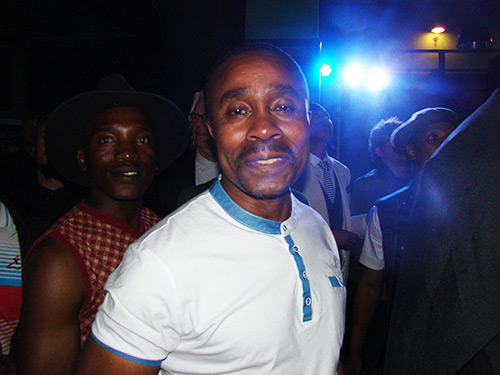 Vusi at the launch of The Road. He wasn't in the show, just sort hanging out at the party.
I went to church, my old church, the church where I was baptised when I was a child.
And when I left, this woman asked why they let me in, why they let a criminal in. They shouldn't let criminals into the church.
When I was told, it bothered me a bit but then later I started to look at it as, you know, I'm doing a good job.
And then there was this woman at a till in one of the supermarkets.
She was closing the till and when this person in front of me moved and she saw me, she froze and she removed that thing that says closed.
TVSA: *laughs* Oh, so that she could serve you.
Vusi: Yes.*
laughs* But she looked so frightened and I said to her: "I thought you were closing".
She said: "No, no, it's okay, it's okay." She served me and then after that, she closed and she went away.
So I wasn't sure if she was frightened, but she looked frightened to me.
TVSA: *laughs* Can you go out to the shops and stuff, or do you get reactions from everybody? Do you get privacy?
Vusi: People generally will come and talk, want to take pictures, while I'm trying to buy. It just depends.
You see, here in Joburg, it's a bit better. When I go outside of Joburg, that's when things happen, to a point that sometimes I end up leaving, because it causes chaos
Like, if I'm in a shop, then I worry that things will happen, things would get stolen.
So I remember when I was in Swaziland at some point, and I was at a market, I ended up having to leave, because people were just running, things were falling over, and I felt bad because I felt like, I caused all this.
And then you also meet people who give you attitude.
TVSA: Like what?
Vusi: They just want to show me that I musn't think that I'm anything special - that kind you know. "I'm not going to serve you just because."
And then somebody will tell you "Eish, he doesn't like celebrities," but you're not here as a celebrity, you're just here to be served,
And also sometimes at restaurants I end up getting served by many people. *
laughs*
This person is serving me, and then somebody else comes back, and I'm thinking, "Okay, maybe he's gone,".
They take the order, and somebody else comes back and takes the order again. "Uh, but I just gave the order."
Somebody else brings the food, and then there's a problem, but I said, you know. *
laughs*
TVSA: Who do you give the tip to?!
Vusi: Yeah, but I don't take it badly. I don't take it badly. I understand.
TVSA: What was your first day on the set of Generations like?
Vusi: My first day on set, unfortunately, wasn't a good day. Honestly, I didn't want to go back after my first day.
I'd never done a soap before, and they shoot differently - they do things differently.
Multi-cam, for instance - I was used to single cam. You do an establish shot, and then you do close-up of this one, of this person, and then you do a close-up of you but here they have three cameras, and they cover all that.
And the way you move is unnatural. You feel, "I don't feel like moving", but you have to move because they plot.
Whereas with the single cam, we can talk and say: "I feel like standing when I do this." and they say: "No, it's fine, do it."
But on soapies you move when they tell you to move, and sometimes you forget because your instinct doesn't tell you to move, and then you get in trouble.
And unfortunately, they don't tell you "This is how we work."
And when you do something wrong, it's like there's something wrong with you, but you've never done this before.
Nobody talked to you about it so it was a horrible day for me. I honestly didn't want to come back. I really didn't like it.
TVSA: That's an interesting thing to know for new actors on the scene - that you get there and it's so different and the feeling you've described happens to the best of us but you obviously went back. *laughs*
Vusi: I had to go back, and I had to find a way. What I did was, okay, they tell me to move. I don't know why I'm moving.
So I had to find a purpose for myself and that helped me.
Somehow they adjusted to me, because even when I did that, I kind of dragged them because it wasn't the way they really wanted me to do it
I wanted to do it with purpose, not just to move here because I have to so the camera can go there.
But I do it deliberately, like I'm thinking : "Oh, I need to get something." So, that's what I did.
They didn't quite like it, but they adjusted to it, and, you know, slowly, slowly, they started understanding me.
We started understanding each other, and that's how I managed to stay.
TVSA: Is there anything else that's on your mind that you'd like to share with us?
Vusi: Just to say, Generations has changed the industry and I'm always grateful for that.
Even when I hear people criticise, criticise, but deep down I know there's a lot of people who shine out there because of what Mr Mfundi Vundla started.
And for me it's a blessing to the South African industry, the film and television industry.